- Community
- News & Updates
- Buying & Selling
- Product Categories
- eBay Groups
- eBay Categories
- Antiques
- Art
- Automotive (eBay Motors)
- Books
- Business & Industrial
- Cameras & Photo
- Clothing, Shoes & Accessories
- Coins & Paper Money
- Collectibles
- Computers, Tablets & Networking
- Consumer Electronics
- Crafts
- Dolls & Bears
- Entertainment Memorabilla
- Gift Cards & Coupons
- Health & Beauty
- Home & Garden
- Jewelry
- Music
- Pottery & Glass
- Specialty Services
- Sports Mem, Cards & Fan Shop
- Stamps
- Toys & Hobbies
- Travel
- Business Insights
- Regional Groups
- Special Interest Groups
- Developer Forums
- Traditional APIs: Orders, resolutions and feedback
- Traditional APIs: Search
- Traditional APIs: Selling
- eBay APIs: Talk to your fellow developers
- eBay APIs: SDKs
- Token, Messaging, Sandbox related issues
- APIs Feedback, Comments and Suggestions
- RESTful Sell APIs: Account, Inventory, Catalog and Compliance
- RESTful Sell APIs: Fulfillment
- RESTful Sell APIs: Marketing, Analytics, Metadata
- Post Order APIs - Cancellation
- Post Order APIs - Inquiry, Case Management
- Post Order APIs - Return
- RESTful Buy APIs: Browse
- RESTful Buy APIs: Order, Offer
- Promoted Listings Advanced
- Seller Meeting Leaders
- 30th Anniversary Celebration
- eBay Live
- eBay Categories
- Community Info
- Events
Turn on suggestions
Auto-suggest helps you quickly narrow down your search results by suggesting possible matches as you type.
- eBay Community
- Buying & Selling
- Shipping
- Shipping Guide: Measuring Packages
Options
- Subscribe to RSS Feed
- Mark Topic as New
- Mark Topic as Read
- Float this Topic for Current User
- Bookmark
- Subscribe
- Mute
- Printer Friendly Page
Shipping Guide: Measuring Packages
Options
- Mark as New
- Bookmark
- Subscribe
- Mute
- Subscribe to RSS Feed
- Permalink
- Report Inappropriate Content
08-11-2025 04:08 PM
Changes are coming! UPS and FedEx, as of next Monday, August 18th, are changing the way they measure. Everything is going to round up and yes, that means you may pay more.
Measuring basics:
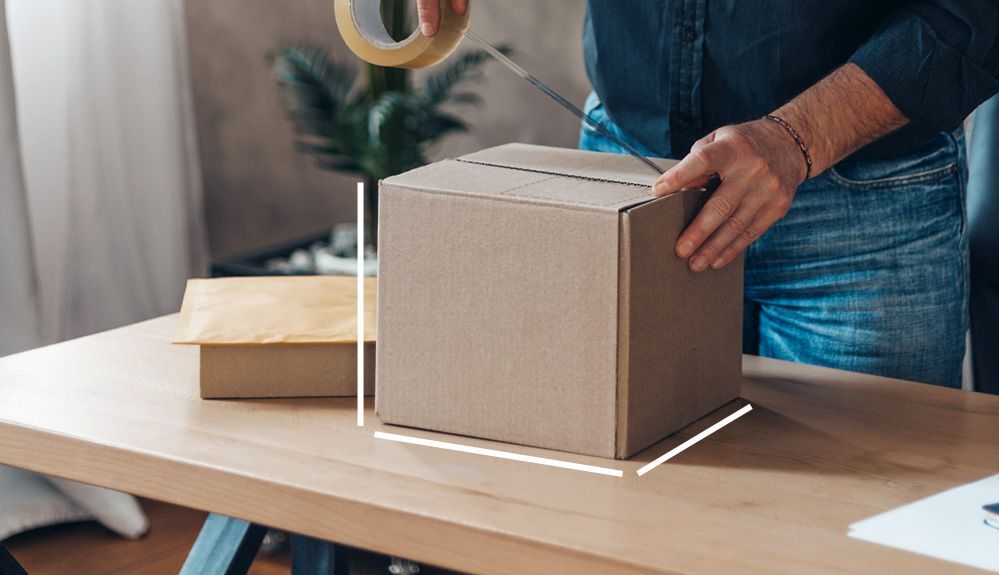
- Always measure outer package dimensions.
- Dimensions printed on the bottom of a box are inner dimensions. Outer dims are typically a bit larger and yes, it does/can/will make a difference on shipping rates.
- Packages can get crushed or skewed in transit which can bump out dimensions and result in unexpected cost adjustments; use sturdy packing materials to minimize this possibility.
FedEx is changing their rounding logic as of August 18th (link).
Old: Dimensions of one-half inch or greater are rounded up to the next whole number; dimensions less than one-half inch are rounded down.
New: Effective August 18, 2025, FedEx will round every fraction of an inch/centimeter up to the next-higher inch/centimeter.
UPS is changing their rounding logic as of August 18th (link).
Old: For each dimension, measure at the longest point, rounding each measurement to the nearest whole number (for example, 1.00 to 1.49 will be considered 1, and 1.50 to 1.99 will be considered 2).
New: Effective August 18, 2025, when determining the dimensions of a package, UPS will round all fractional measurements of any package dimension up to the next whole inch, including length, width and height. For example, if the length of a package is 11.1 inches, that package will be deemed to have a length of 12 inches.
UPS is also changing the Large Package Surcharge & the Domestic Additional Handling Surcharge effective August 17, 2025. These surcharges will no longer be based on length + girth, but on cubic volume instead. You can review a summary on eBay's update here and on the UPS website here.
USPS is not making changes at this time. USPS rounding logic is different for standard weighted packages vs packages rated by cubic volume.
USPS DMM 604.7.1.3 Rounding Numerical Values
For these standards:
- Round off requires increasing by 1 the last digit to be kept if the digit to its right, which is not to be kept, is 5 or greater. If that digit is 4 or less, the last digit kept is unchanged (e.g., 3.376 rounded off to two decimal places is 3.38, 3.374 is 3.37).
- Round up requires increasing by 1 the last digit to be kept if there are any digits to its right, regardless of significance (e.g., rounding up either 3.3701 or 3.379 to two decimal places yields 3.38).
- Round down requires eliminating any digits to the right of the last number to be kept (e.g., rounding down either 3.371 or 3.379 to two decimal places yields 3.37).
USPS DMM 223.1.3.3 Determining Cubic Tier Measurements for Rectangular and Nonrectangular Parcels
Follow these steps to determine the cubic tier measurement for rectangular and nonrectangular parcels:
a. Measure the length, width, and height at each dimension’s maximum point, in inches. Round down (see 604.7.0) each measurement to the nearest 1/4 inch. For example, 6-1/8" x 5-7/8" x 6-3/8" is rounded down to 6" x 5-3/4" x 6-1/4".
b. Multiply the length by the width by the height and divide by 1728. For example: 6" x 5-3/4" x 6-1/4" = 215.6 divided by 1728 = 0.125 (This piece exceeds 0.10 - Tier 1 threshold). It is calculated at Tier 2 - 0.101 to 0.20.
Standard Rectangular:
USPS DMM 223.1.4.2 Determining Dimensional Weight for Rectangular Parcels
Follow these steps to determine the dimensional weight for a rectangular parcel:
a. Measure the length, width, and height in inches. Round off each measurement to the nearest whole inch.
b. Multiply the length by the width by the height.
c. If the result exceeds 1,728 cubic inches, divide the result by 166 and round up to the next whole number to determine the dimensional weight in pounds.
d. If the dimensional weight exceeds 70 pounds, the customer pays the 70-pound price.
USPS DMM 223.1.4.3 Determining Dimensional Weight for Nonrectangular Parcels
Follow these steps to determine the dimensional weight for a nonrectangular parcel:
a. Measure the length, width, and height in inches at their extreme dimensions. Round off (see 604.7.0) each measurement to the nearest whole inch.
b. Multiply the length by the width by the height.
c. Multiply the result by an adjustment factor of 0.785.
d. If the final result exceeds 1,728 cubic inches, divide the result by 166 and round up (see 604.7.0) to the next whole number to determine the dimensional weight in pounds.
e. If the dimensional weight exceeds 70 pounds, the customer pays the 70-pound price.
----------
Note: eBay listing form does not accept decimals; always round up on the listing form. eBay label page does accept decimals and you can use them for more exact USPS rates.
Bottom line: Always enter accurate outer dimensions and eBay's shipping calculator will do the work for you. If your package is 'borderline', round up to avoid unexpected cost adjustments.
Message 1 of 18
- « Previous
-
- 1
- 2
- Next »
17 REPLIES 17
Shipping Guide: Measuring Packages
Options
- Mark as New
- Bookmark
- Subscribe
- Mute
- Subscribe to RSS Feed
- Permalink
- Report Inappropriate Content
08-19-2025 06:52 PM
@powell-collectibles wrote:
@lisa5768 wrote:
Thank you for this info. I have always and advised others to round up to the nearest inch. I will also add an extra inch maybe two when I ship in soft packaging like poly bags since their dimensions can change when moving through machinery. I don't ship large items so there is lots of room before hitting dimensional pricing. While cubic pricing is nice I don't worry about trying to fit my package to it. If I do get the lower cost that is just extra money in to my self insurance and supplies fund.
Understood that some might do this - but it is puzzling to me. Paying more to avoid the small chance that you’ll pay more seems like a money-losing strategy.
Same here. Just measure the required way. I like all the money deposited in my bank account. I could care less if they come back with a 2 dollar charge because they disagree with my measurement.
I have shipped a few thousand or so with UPS over the years and they have come back and charged me 3 times. Never more than a few dollars.
With USPS, I think I have had 2 debits and 2 credits.
Posting ID
Message 16 of 18
Shipping Guide: Measuring Packages
Options
- Mark as New
- Bookmark
- Subscribe
- Mute
- Subscribe to RSS Feed
- Permalink
- Report Inappropriate Content
08-20-2025 07:27 PM
@wastingtime101 wrote:
@gator08041971 wrote:I already round all packages up to the next largest inch anyway, mostly to cover my butt. I wasn't even aware they were using fractional amounts..
That's pretty common! eBay also recommends rounding up as the safest bet.
I always tell new sellers to round up (even though they may pay a bit more) because shipping can be complicated enough without getting into the various rounding rules, especially with USPS.
I don't think it makes sense to always round up. It can make the buyer unnecessarily pay more. One of the box sizes that I get through Ebay Shipping Supplies is marked 16X12X8. The 8 dimension, I believe is not realistic based upon what happens when the box is set up and closed, so I need to round that up, so I enter 16X12X9. If you multiply those all together, it comes out to 1728 cubic inches, which is the limit before big dimensional weight charges begin. If I rounded all the numbers up to 17X12X9, the customer would see a bigger charge (potentially much higher and may decide not to buy), and I'd then pay a higher charge.
Message 17 of 18
Shipping Guide: Measuring Packages
Options
- Mark as New
- Bookmark
- Subscribe
- Mute
- Subscribe to RSS Feed
- Permalink
- Report Inappropriate Content
08-20-2025 08:59 PM
If the 16 is the measurement then it is not a # that needs to be "rounded up". Rounded up only if it exceeds the inch.
Message 18 of 18

- « Previous
-
- 1
- 2
- Next »
- « Previous
-
- 1
- 2
- Next »
About this board
Welcome to the Shipping board! Here you can discuss all things shipping with other members.
For news and more see:Shipping related questions? Start here:
Featured Posts