Totally agree. Week ago I bought an ASE from a seller listed as 98% positive feedback. But price for the coin was WAY below actual retail price. Figured it was a fake, but ordered anyway to see what I would receive and how it compared to a genuine ASE. Took 8 days to arrive via slow boat to China (pun intended) using worthless USPS. Got it out and it looked ok. Not a bad fake. Finish was a bit dull. It actually weighed 31 g. But did my ping test, and app on phone showed it was fake, got copper frequencies. Then checked for the security notch and it was 2 notches wide, not just one. Reported to EBay. BTW, seller address was fake, too. Took an hour or so to get this remedied but obviously EBay doesn't lift a finger to vet these bogus sellers. Almost running a fencing operation for theft rings and coutnerfeiters.
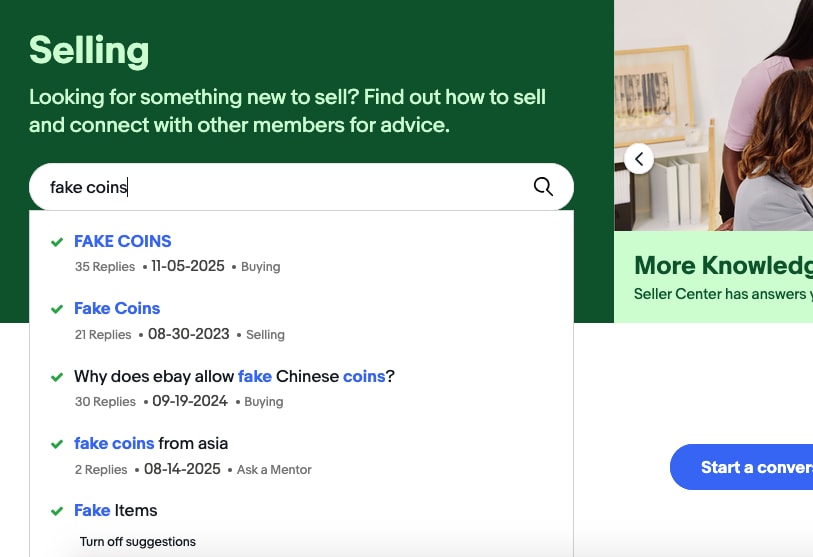
@good-old-things I see this is your first post in the Seller forum. WELCOME! To get the most out of the forum, one of the easiest things you can do is use the search bar at the top of the screen, to see if there are already threads about your question. Then you can quickly find the answers already given, and it keeps the feed from having the same posts over and over again. (This fake coin one is painfully common, LOL)
Counterfeit items are not allowed to be listed on eBay at all. No one is authorized to sell counterfeit items. That fact alone does not stop some people from trying to sell them, however.
The problem is that unscrupulous or uninformed sellers can list genuine items and then deliver counterfeit items.
It is not always possible to look at a listing and know in advance exactly what, if anything, the seller intends to deliver. For one thing, a scammer can simply copy a listing from a genuine seller, using a genuine photo of a genuine item.
Except for a few specific categories of items that go through authentication, eBay never sees what the seller ships or the what the buyer receives, so there is nothing for eBay to check unless someone complains about what was received by invoking eBay's money back guarantee.
Sellers are responsible for the descriptions they provide, and buyers should not assume that eBay screens the listings in advance.
As long as counterfeits exist and there are folks trying to sell them, buyers will still have to be on the lookout for them, and avoid deals that are obviously too-good-to-be-true, whether they are being sold by accounts registered overseas or by domestic sellers wittingly or unwittingly buying counterfeits from overseas to sell here.
Buyers that doubt their ability to distinguish a genuine article from a counterfeit one should only consider purchasing from trustworthy sellers that have an established reputation for delivering exactly what was described, and should avoid deals that are too-good-to-be-true, or deals that are offered by inexperienced sellers that might disappear soon after the transaction is made, or else be prepared to get items authenticated by trusted sources within thirty days to be able to take advantage of eBay's money back guarantee.
Really the policy and vetting limitations you ascribe to Ebay means one thing. It is a wide open, unmonitored fencing outlet for theft rings and counterfeitiing operations. Nothing like offering your customers a store populated by so many grifters and dishonest criminals. Here's one way to stop it. When seller uses the USPS to send U.S. currency (coin or paper) to ship its fake goods, that makes Ebay an accessory to mail fraud and shipping counterfeit currency via the mail, plus across state lines.
@jerub_2556 You know which online platforms don't have this problem? The ones that don't allow coin sales at all. Is that what you want? Because it almost happened when eBay switched from Paypal to Managed Payments. Coins were going to be prohibited PERIOD, but the outcry from the hobby community got them to see the light.
There is no way for them to prevent all sales of fake (anything -coins, jewelry, fashion, YOU NAME IT) without having everything sent to authenticators, and that is NE-VER going to happen for items priced as low as a single ASE. Get real.
Sometimes, even after being 'authenticated' by eBay employees (or?), the item turns out to be fake. Today, especially with AI, 3D printers, et. al., it's not as hard to create a near perfect fake that can fool even the experts.
I assume there is a cost with having something authenticated.
Are graded coins with provenience also faked on eBay, including the protective case and paperwork? If yes, then the thieves are getting really clever.
I hope coin collectors find a way to stop or at least slow down this rip.
I bought a coin and not paying attention did not realize it was from a Chinese seller. The coin arrived but my red flag was the price was way too low for that coin and condition. I paid $40 and the price is actually $400-$600. I weighed it and looked at it under magnification and all checked out. I still need to take it to a professional before I actually add it to my collection.
Because they do not know whether any coins are counterfeit. They have no expertise in any form of merchandise.
They determine whether sellers are meeting their requirements by measurements which include the claims filed by buyers who have purchased items they believe to be counterfeit.
They learned years ago to not trust reports filed by a seller's competitors.
If it's advertised as actual gold or silver and it's being offered on eBay for a price below spot, there's a 99.8% chance that it's a plated piece of base metal.
For every alleged gold or silver coin that is priced below spot on eBay, there are probably a hundred gold or silver jewelry pieces priced below spot. And cutlery, and serveware, and watches, and decorative pieces, and .....
-some of them plated junk and the seller knows it, some of them plated junk and the seller doesn't know it, some of them totally legit and the seller doesn't know it (that their price should be higher).
Now imagine the insane bot programming that would be required to prohibit listings of precious metal items being offered under the price of a market that changes by the minute.

jerub_2556
·8 months agoTotally agree. Week ago I bought an ASE from a seller listed as 98% positive feedback. But price for the coin was WAY below actual retail price. Figured it was a fake, but ordered anyway to see what I would receive and how it compared to a genuine ASE. Took 8 days to arrive via slow boat to China (pun intended) using worthless USPS. Got it out and it looked ok. Not a bad fake. Finish was a bit dull. It actually weighed 31 g. But did my ping test, and app on phone showed it was fake, got copper frequencies. Then checked for the security notch and it was 2 notches wide, not just one. Reported to EBay. BTW, seller address was fake, too. Took an hour or so to get this remedied but obviously EBay doesn't lift a finger to vet these bogus sellers. Almost running a fencing operation for theft rings and coutnerfeiters.
gurlcat
·8 months ago@good-old-things I see this is your first post in the Seller forum. WELCOME! To get the most out of the forum, one of the easiest things you can do is use the search bar at the top of the screen, to see if there are already threads about your question. Then you can quickly find the answers already given, and it keeps the feed from having the same posts over and over again. (This fake coin one is painfully common, LOL)

good-old-things
OP8 months agoI buy nothing on eBay from Asia, especially China. If it's cheap, you know it's a fake.
gurlcat
·8 months agoWell there you go, nothing to worry about then.
eburtonlab
·8 months agoCounterfeit items are not allowed to be listed on eBay at all. No one is authorized to sell counterfeit items. That fact alone does not stop some people from trying to sell them, however.
The problem is that unscrupulous or uninformed sellers can list genuine items and then deliver counterfeit items.
It is not always possible to look at a listing and know in advance exactly what, if anything, the seller intends to deliver. For one thing, a scammer can simply copy a listing from a genuine seller, using a genuine photo of a genuine item.
Except for a few specific categories of items that go through authentication, eBay never sees what the seller ships or the what the buyer receives, so there is nothing for eBay to check unless someone complains about what was received by invoking eBay's money back guarantee.
Sellers are responsible for the descriptions they provide, and buyers should not assume that eBay screens the listings in advance.
As long as counterfeits exist and there are folks trying to sell them, buyers will still have to be on the lookout for them, and avoid deals that are obviously too-good-to-be-true, whether they are being sold by accounts registered overseas or by domestic sellers wittingly or unwittingly buying counterfeits from overseas to sell here.
Buyers that doubt their ability to distinguish a genuine article from a counterfeit one should only consider purchasing from trustworthy sellers that have an established reputation for delivering exactly what was described, and should avoid deals that are too-good-to-be-true, or deals that are offered by inexperienced sellers that might disappear soon after the transaction is made, or else be prepared to get items authenticated by trusted sources within thirty days to be able to take advantage of eBay's money back guarantee.
jerub_2556
·8 months agoReally the policy and vetting limitations you ascribe to Ebay means one thing. It is a wide open, unmonitored fencing outlet for theft rings and counterfeitiing operations. Nothing like offering your customers a store populated by so many grifters and dishonest criminals. Here's one way to stop it. When seller uses the USPS to send U.S. currency (coin or paper) to ship its fake goods, that makes Ebay an accessory to mail fraud and shipping counterfeit currency via the mail, plus across state lines.
gurlcat
·8 months ago@jerub_2556 You know which online platforms don't have this problem? The ones that don't allow coin sales at all. Is that what you want? Because it almost happened when eBay switched from Paypal to Managed Payments. Coins were going to be prohibited PERIOD, but the outcry from the hobby community got them to see the light.
There is no way for them to prevent all sales of fake (anything -coins, jewelry, fashion, YOU NAME IT) without having everything sent to authenticators, and that is NE-VER going to happen for items priced as low as a single ASE. Get real.
grann-4629
·8 months agoSometimes, even after being 'authenticated' by eBay employees (or?), the item turns out to be fake. Today, especially with AI, 3D printers, et. al., it's not as hard to create a near perfect fake that can fool even the experts.
I assume there is a cost with having something authenticated.
Are graded coins with provenience also faked on eBay, including the protective case and paperwork? If yes, then the thieves are getting really clever.
I hope coin collectors find a way to stop or at least slow down this rip.
😎
jdbelt1960
·8 months agoI bought a coin and not paying attention did not realize it was from a Chinese seller. The coin arrived but my red flag was the price was way too low for that coin and condition. I paid $40 and the price is actually $400-$600. I weighed it and looked at it under magnification and all checked out. I still need to take it to a professional before I actually add it to my collection.
tobaccocardyahoo
·8 months agoBecause they do not know whether any coins are counterfeit. They have no expertise in any form of merchandise.
They determine whether sellers are meeting their requirements by measurements which include the claims filed by buyers who have purchased items they believe to be counterfeit.
They learned years ago to not trust reports filed by a seller's competitors.
tools*
·8 months agoIf it's advertised as actual gold or silver and it's being offered on eBay for a price below spot, there's a 99.8% chance that it's a plated piece of base metal.
gurlcat
·8 months agoFor every alleged gold or silver coin that is priced below spot on eBay, there are probably a hundred gold or silver jewelry pieces priced below spot. And cutlery, and serveware, and watches, and decorative pieces, and .....
-some of them plated junk and the seller knows it, some of them plated junk and the seller doesn't know it, some of them totally legit and the seller doesn't know it (that their price should be higher).
Now imagine the insane bot programming that would be required to prohibit listings of precious metal items being offered under the price of a market that changes by the minute.
slippinjimmy
·8 months agoWhy do banks allow people to rob banks?