Please I need help identifying a vintage European porcelain Mark
Please I need help identifying a vintage European porcelain Mark。 In communist China, you can’t use Google, but you can use Bing, but you can’t recognize pictures use Bing' s visual search, so I can only say thank you.😂
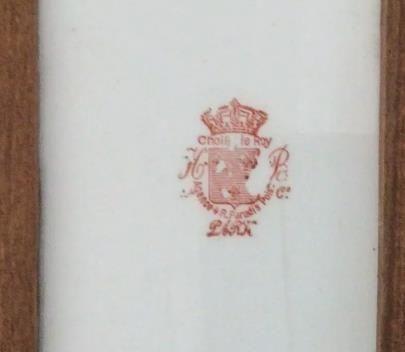

waxu_93
15 comments
1949labman
It is French...Choisy le Roy.
glenvonnie
From another site:
"
The Choisy-Le-Roi faience factory was actually name for the city it was founded in (Choisy Le Roi, France). The produced majolica pieces from about 1860 to 1910. They used 4 main marks. Your mark is the black ink stamp that is found most often. It features an HB, which stand for Hippolyte Boulenger a director at the pottery.
The plate is one of the pieces from their Asian aesthetic period. It was a great series. They were made using the Email Ombrant technique, which is sort of like creating lithophanes. A picture or design would be etched into the pottery, and then a transparent colored glaze would be poured over it, so the surface would be smooth after firing.
Your plate should date to roughly around 1880 and it should be worth about $100 to $125."
"
Choisy-le-Roi
Faience pottery was first produced in Choisy-le-Roi in 1804. By 1836, the factory came under the management of Louis Boulenger who was succeeded in 1863 by his son Hippolyte Boulenger. By that time, the factory employed some three hundred skilled workers operating four kilns. A large number of majolica designs were added to production in the early 1860s and continued until 1910.
At the conclusion of the Franco-Prussian war, Alsace-Lorraine was annexed by Germany. Sarreguemines, Choisy-le-Roi’s primary competitor in majolica production, became German territory. A number of Sarreguemines workers rejected German nationality and brought important technical skills and artistry to Choisy-le-Roi. Thereafter, Boulenger was producing the finest majolica in France and received acclaim at the Paris Exhibition of 1878 and other international exhibitions.
Choisy majolica was precisely glazed and compares favorably to that of the major British manufacturers. Among the most impressive pieces are monumental hen, rooster and other bird vases modelled by Paul Comolera and Louis-Robert Carrier-Belleuse. The most common are leaf plates with a greek key border and various asparagus items.
When marked, majolica pieces bear a stamped ‘Choisy le Roi’ or ‘Choisy’ and may include the letters HB (presumably for Hippolyte Boulenger.)"
waxu_93
OPThank you so muchï¼ðŸ˜Š
lacemaker3
I wondered if it might be Choisy le Roi as well, but the last word is very clearly spelled with a y, not an i. Which makes this piece suspicious as a possible forgery.
Where did you find that information? It's always best to post the source. You're allowed to post links for references.
Edit: I found the site, and they have blocked the photographs so there is no way to see what mark they are describing, or whether it is like the one on @waxu_93's plate or not. I would not consider that site to be an unbiased (or useful) reference, TBH, because they are giving "expert appraisals" (self-described), so they have a vested interest in saying the items are valuable. (I won't post the link because I don't know it to be reliable.)
From what I can see, the company H Boulenger & Cie, located in Choisy-le-roi, used several different marks, but none were like the one on @waxu_93's piece, and they always spelled the name of the city correctly. So I don't think this has been properly identified, yet.
https://www.infofaience.com/en/marks/choisy-le-roi-marks
An example from the British Museum:
https://www.britishmuseum.org/collection/object/H_2018-8041-1
waxu_93
OPI also have a porcelain plate painting produced by HB Co., which has no conventional markings.
lacemaker3
@waxu_93, thanks for all the additional info.
While researching this, I have seen an impressed mark H. B. Choisy or H.B.&Cie. Choisy on a number of pieces, sometimes with the usual H. B. & Cie. mark (shown here), so that appears to be a legitimate mark for H Boulenger & Cie. "Cie." is the abbreviation for Compagnie, the French word for Company.
For example: https://www.gazette-drouot.com/en/lots/19281282-h-b-cie--choisy-le-roi-box---
waxu_93
OP@lacemaker3 Thank you for your interest in this item. I have another one at home, but it only has H and no B. Also a product of Limoges, France.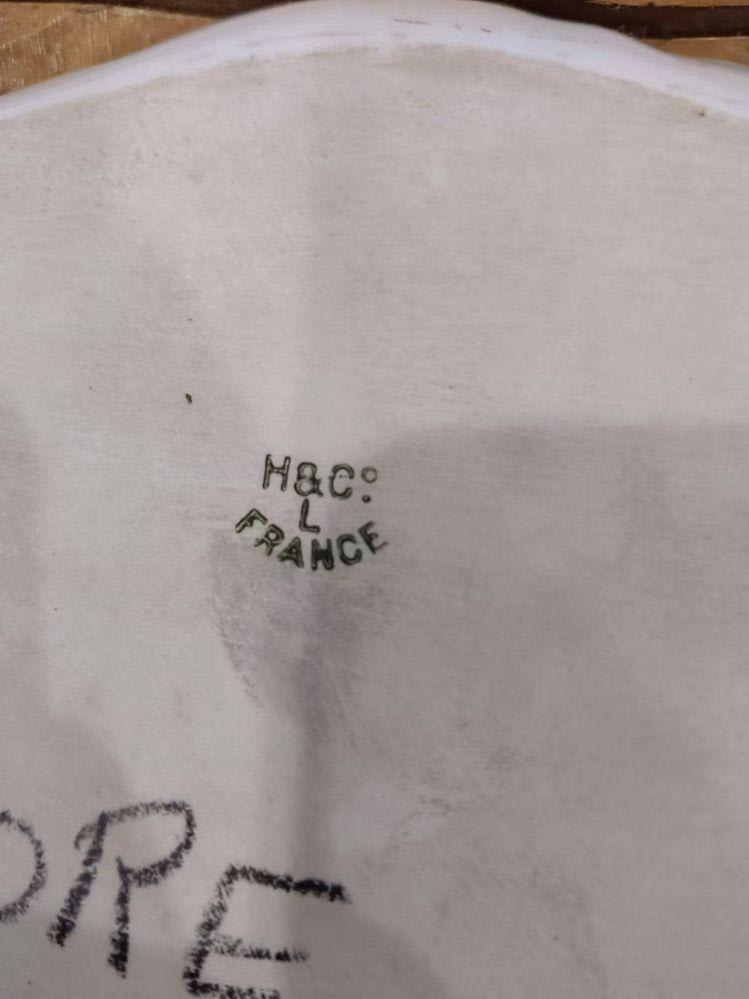
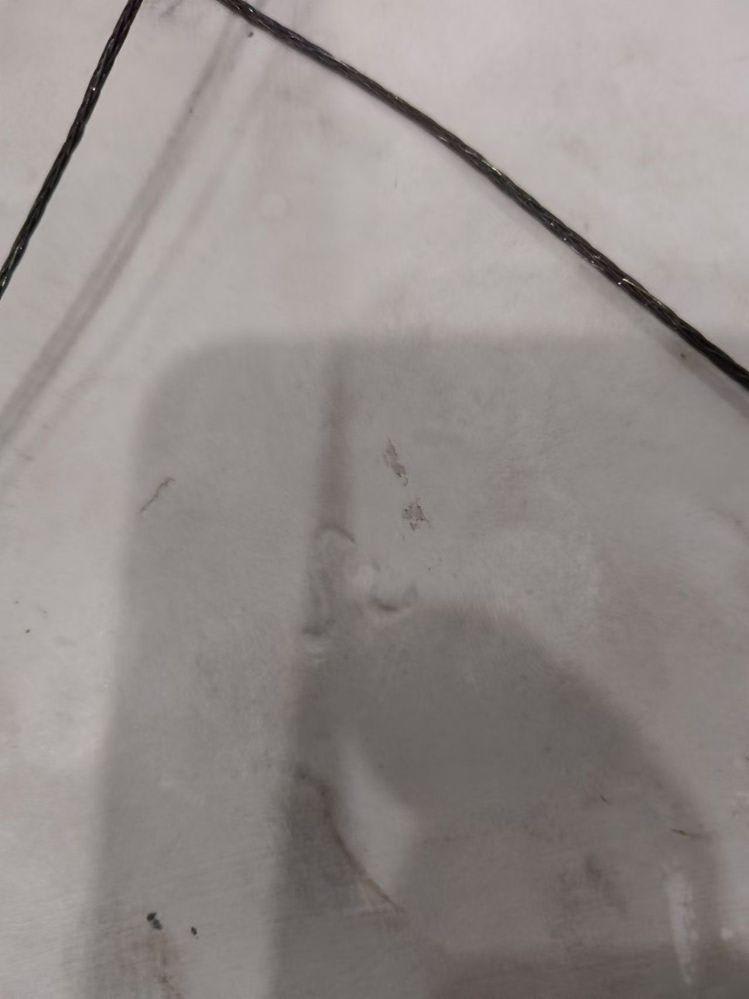
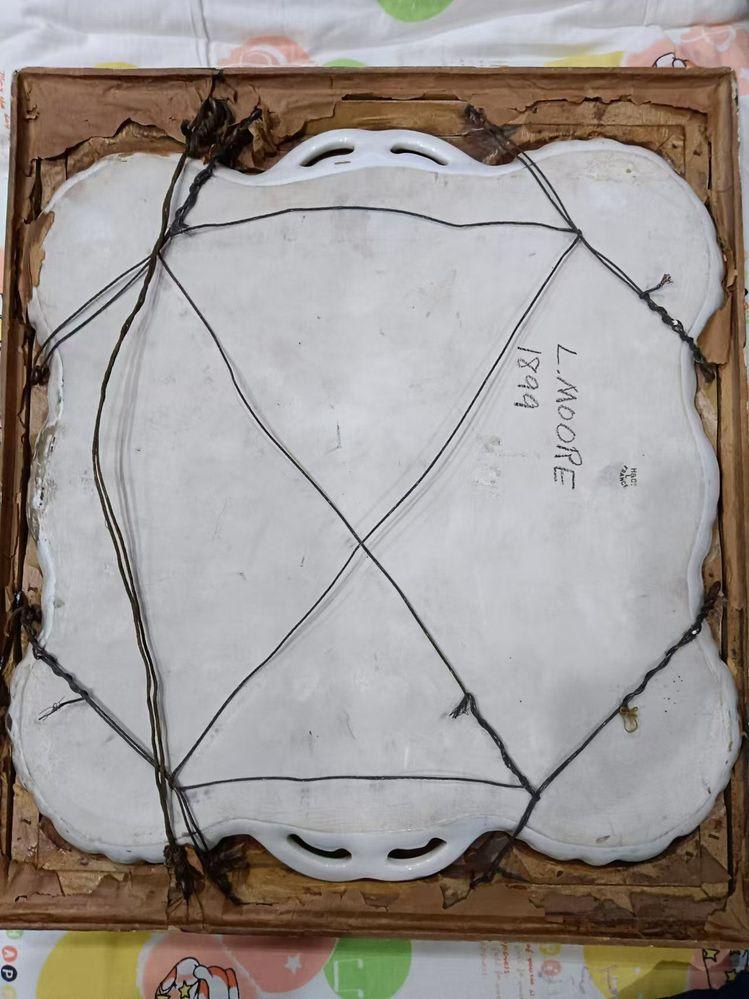
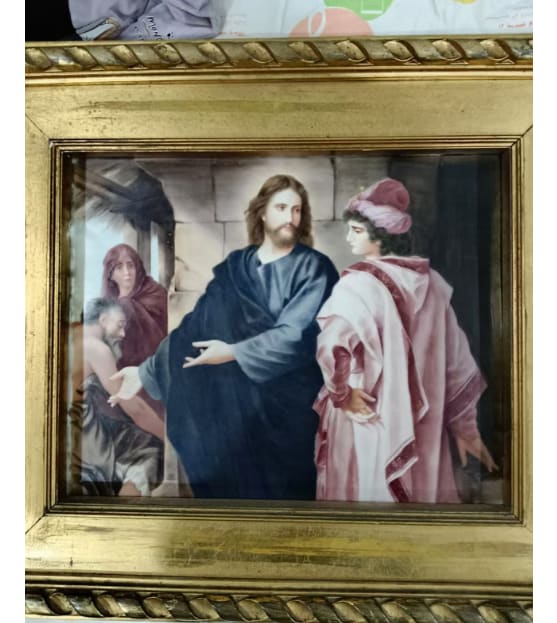
The Pharisees did not allow people to be healed on the Sabbath and were rebuked by Jesus
lacemaker3
@waxu_93,
That is from a different company: Haviland & Co, Limoges, France. Here another example of their mark with the identification:
However, Choisy-le-Roi is not in Limoges. It's actually about 383 km away from Limoges.
lacemaker3
Would you be able to post a clearer picture?
I'm not sure if the mark itself is blurry, or if the picture is a bit out of focus.
I think the wording might be in French, but it's very hard to read.
That picture is very small, even just a higher resolution picture would be better, even if the mark itself is blurry.
waxu_93
OPI just filed my tax declaration at the China customs APP today and it will probably take another 2 weeks to be received . This is the picture given by the seller of ebay.
Thank you!
lacemaker3
Can you share the link to the listing, please, so we can see the rest of the pictures?
wastingtime101
No time for me to research right now, but if it helps @lacemaker3 , this listing has the same mark.
https://www.ebay.com/itm/255124596369
Not the one OP bought since it's still active.
lacemaker3
Well, that is also blurry, in all 3 pictures, so I suppose that the mark itself is blurry, on both these pieces.
With that one, I can confirm that the shield in the center shows the arms of France (three fleur-de-lys), which is not used on any of the other marks for H Boulenger & Cie, and that the name of the city is spelled wrong again.
This makes me suspicious that it may be a forgery.
waxu_93
OPhttps://www.ebay.com/itm/226472508382
I don’t know if you can open the link. You are already on your way to China.
lacemaker3
Thanks, @waxu_93, that is helpful because I can enlarge the image of the mark, and the seller was able to make out some of the wording that is not very clear in the picture.
I found another example of this mark, on a painted plate that is also signed Gerard, like your piece. This mark is a bit clearer in some areas, so between them, we can figure out most of the words. This was a post asking for help to identify the maker, but unfortunately, there were no replies.
https://www.figurines-sculpture.com/pottery-mark-query-choify-le-roy-hb-et-co-paris-crown-shield-fleurs-de-lis.html
And, this is the clearest version of the mark that I have been able to find: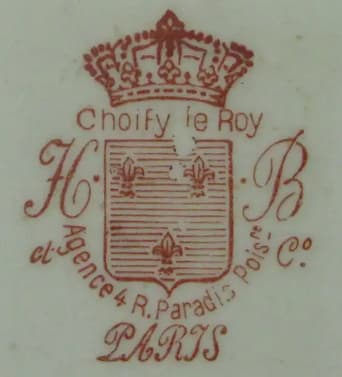
The wording that curves around the bottom of the shield is an address, possibly of the company that commissioned the piece. The seller of your piece was able to make out the address, and put it in the description. I have added some corrections based on the other pictures shown above. Agence means Agency or Agents, and Poisre. is an abbreviation for Poissonnière, or fish-seller, and this is what the street was called at the time: Rue de Paradis-Poissonnière . Now, it is just called Rue de Paradis or Paradise Street.
So the whole mark says:
Choify le Roy
H. B. et Co
Agence 4 R. Paradis Poisre
PARIS
H.B. & Cie. had their store just down the road from there, from 1889 on, at 18 rue de Paradis (the pictures of the building in the tripadvisor link below are very beautiful, with ceramic plaques and decoration):
https://www.tripadvisor.com/Attraction_Review-g187147-d14039513-Reviews-Faiencerie_Boulenger-Paris_Ile_de_France.html
Agence is French for Agency, or Agents, so I believe this is the address of a retailer, who may have been marketing ceramic pieces that they had commissioned from H.B. & Cie. They may have been working with, or on behalf of, an artist named Gerard. Or perhaps he was an employee. He was certainly a talented painter.
My theory is that that this company was buying blank pieces from H.B. & Cie, and having them decorated and then marketing them to the United States or other English-speaking countries. Or they may have been acting as agents for H.B. & Cie.
Waxu's piece was from the UK, and the plate I linked to above, and the one @wastingtime101 found, were from the United States. The marks on these three pieces use archaic (very old fashioned) spelling for the City name, and "et Co.", the abbreviation of the English word Company, instead of "& Cie." which is the French abbreviation for Compagnie. I think this was done to make them more appealing, or understandable, to the American (or English-speaking) market. That may also be why they decided to use the arms of France in the mark.
The archaic spelling for Choisy-le-Roi would have been "Choiſy le Roy", using a long s in the first word. But in the late 19th century, the long s ( ſ ) was no longer in use, and was usually mistaken for an f. That would have resulted in "Choify le Roy". This was a common substitution in archaic (English) spelling from that time.
They were probably made in the late 19th or early 20th century, because they don't say "Made in France" which was required later for pieces being imported into the United States.