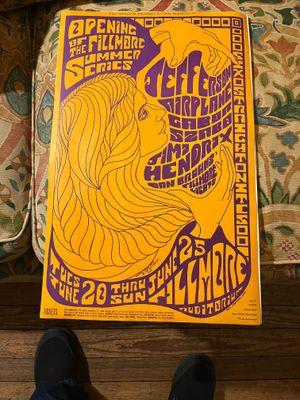
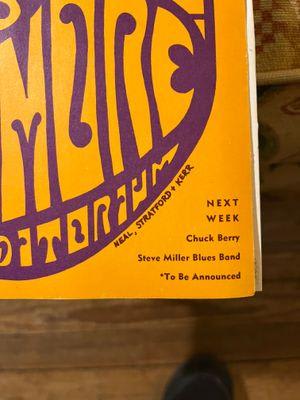
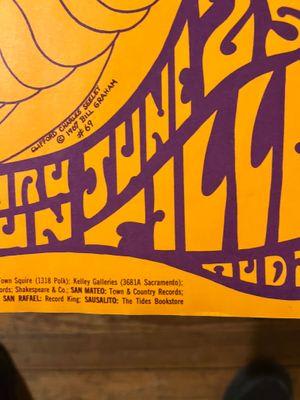
The originals of these concert posters were made using lithography. There should be no "pixelation" of the image where the colors are made up of a field of tiny dots rather than a solid mass of color. If you see the dot matrix through a magnifying glass, it is a photo copy.
As @mopata has described, these 1960s posters were originally printed using a lithographic process, rather a more modern copying procedure.
A photo that would be most helpful would be a VERY deep close-up (using a magnifying glass, if possible) of any inked portion of the front of the poster, which displays the contrasting colors (purple and gold inks).
What we are looking for is the dot pattern that would be disclosed under deep magnification.
I am not positive, but if those are panetone Inks they would be solid with no dots. Since there are no photos it’s probably one color of ink on orange stock. No dots Judy

mopata
The originals of these concert posters were made using lithography. There should be no "pixelation" of the image where the colors are made up of a field of tiny dots rather than a solid mass of color. If you see the dot matrix through a magnifying glass, it is a photo copy.
1786davycrockett
@ivanhoeinred
As @mopata has described, these 1960s posters were originally printed using a lithographic process, rather a more modern copying procedure.
A photo that would be most helpful would be a VERY deep close-up (using a magnifying glass, if possible) of any inked portion of the front of the poster, which displays the contrasting colors (purple and gold inks).
What we are looking for is the dot pattern that would be disclosed under deep magnification.
judy181garden
I am not positive, but if those are panetone Inks they would be solid with no dots. Since there are no photos it’s probably one color of ink on orange stock. No dots
Judy
melda58
Maybe the OP @ivanhoeinred will be good enough to wander back and let you all know if there are dots or no dots.
Rita