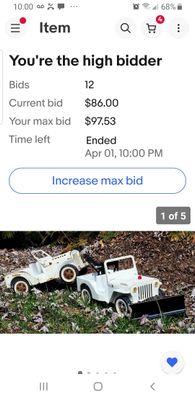
The "cheesy" part is that the information shown in the first image is incomplete: You were the high bidder, and the auction had ended, BUT the final bid had not yet been processed by all of eBay's servers. Another bid came in after yours, before the auction ended. This is a problem with eBay's display process, not with the way they handled the bids on that auction.
Nibble bidding is fun, but not a useful way to win.
Especially in the last hour of bidding, make only ONE bid and make it as high as you are willing to pay....
That's what the OP did: They placed only one bid on that auction and they placed it when the auction had just 13 seconds left. That doesn't meet everyone's definition of a snipe bid, but certainly could be regarded as "last minute" bidding.
Looks to me like the high bid from the OP was $97.53.
When experienced eBay auction bidders say "Bid Early and Bid Your Maximum Payment" this means, bid the highest amount you are willing to pay. eBay's computers understand this as "mi2high has told us he will pay $97.53 for these toys and not one penny more."
Then along comes another bidder and bids, say, exactly $98.53. Or maybe $99.00. Or maybe that other bidder is willing to pay One Hundred Dollars. It appears that the minimum bid increment on this auction was $1.00. As long as A Bid, anybody's bid, for at least one dollar more than "mi2high's" $97.53, comes in before the moment that the auction ends, mi2high will be outbid.
It's a hard lesson for new eBay bidders to learn but you can't always win.
mudshark61369
"There is no such thing as foolproof, because fools are so darned ingenious" (unknown)3115View listings
@mi2high,
The Bid History shows, your bid was accepted at 7:59:48 PDT, but one more bid came in at 7:59:56 PDT. The auction ended at 8:00:01 PDT. The auction was sniped with 5 seconds left. You should have refreshed your screen just after the auction ended. When trying to snipe, bid the absolute highest amount you are willing to pay for an item.
The countdown you see is not a real-time feed of bids coming into eBay's servers and the eBay clock counting down. Rather, it is a script that runs on your computer and calls for updates on the auction status about every 3 seconds. It uses the time remaining from those updates to start your own computer's clock counting down from the time the page loads or the last successful update, and displays the "current price" and your status as of the last successful update.
Meanwhile, on eBay's end, a bid coming in is timestamped before eBay does anything else with it. If it gets the timestamp before the end of the last second of the auction, it is a timely bid. Then the bid must be processed to see that it is a valid bid for that item (meets the currently calculated minimum bid amount, not subject to a seller block or over the Buyer Activity Limit or from an account with a bidding suspension, timestamped before the end of the auction) before it is handed over to the server that is calculating the status of the auction. This is usually all done in a fraction of a second, but sometimes can take a couple of seconds. Only after the status server calculates the new "current bid" and leader is that information available to be sent in response to an update request from your computer (and it takes some fraction of a second for your request to get to eBay's servers and another for it to get back, get loaded into RAM, and get displayed on your screen, and the script runs the clock down from when the new "time remaining" loads in RAM, which usually results in your countdown being slow because of the time lag).
So, between the 3 second (at best, not all updates are succesful) gaps and the time to process a new bid, there is always at least a 1-4 second window at the end where the results of a new bid will NOT display on your countdown screen before YOUR clock reaches 0 and the script calls for a full refresh of the Item Page. At that time the results of the late bid usually come up (you are not seeing the actual bid, you are seeing the calculated "winning price" or "current bid"), but I always (and everyone should) give it a few seconds and then manually refresh just to be sure before relying on the result as final (again, on a busy night it might take a few seconds to finish processing a bid).
If you bid your TRUE maximum, it doesn't make any difference whether you saw the bid before your countdown ran out--if you had been able to react to it before the auction ended you wouldn't have reacted anyway, since you would not let yourself bid more than the MOST you would be willing to pay. If you did not bid your TRUE maximum and were unable to react, now you know why it is important to bid your true maximum REGARDLESS of what anyone else appears or doesn't appear to be bidding. Highest bid received (but not cancelled/retracted) before the auction ends win, but the price is set by the high bid of the SECOND highest bidder (again, as of what is received but not cancelled/retracted before the end) so it is not necessary to take into account what others have bid, what you guess they have bid, or what you guess they MIGHT bid (except to assume it's about the same as you so add a few cents to the round number you think is your TRUE maximum as a tie-breaker) and expecting to react to other bids as they come in is a recipe for losing at less than you are willing to pay.


nobody*s_perfect
The "cheesy" part is that the information shown in the first image is incomplete: You were the high bidder, and the auction had ended, BUT the final bid had not yet been processed by all of eBay's servers. Another bid came in after yours, before the auction ended. This is a problem with eBay's display process, not with the way they handled the bids on that auction.
femmefan1946
Nibble bidding is fun, but not a useful way to win.
Especially in the last hour of bidding, make only ONE bid and make it as high as you are willing to pay.
Then sit back.
It is not the last bid that wins, it is the highest bid.
The winning bid is set by the underbidder.
nobody*s_perfect
That's what the OP did: They placed only one bid on that auction and they placed it when the auction had just 13 seconds left. That doesn't meet everyone's definition of a snipe bid, but certainly could be regarded as "last minute" bidding.
monroe67
Looks to me like the high bid from the OP was $97.53.
When experienced eBay auction bidders say "Bid Early and Bid Your Maximum Payment" this means, bid the highest amount you are willing to pay.
eBay's computers understand this as "mi2high has told us he will pay $97.53 for these toys and not one penny more."
Then along comes another bidder and bids, say, exactly $98.53. Or maybe $99.00.
Or maybe that other bidder is willing to pay One Hundred Dollars.
It appears that the minimum bid increment on this auction was $1.00.
As long as A Bid, anybody's bid, for at least one dollar more than "mi2high's" $97.53, comes in before the moment that the auction ends, mi2high will be outbid.
It's a hard lesson for new eBay bidders to learn but you can't always win.
mudshark61369
@mi2high,
The Bid History shows, your bid was accepted at 7:59:48 PDT, but one more bid came in at 7:59:56 PDT. The auction ended at 8:00:01 PDT. The auction was sniped with 5 seconds left. You should have refreshed your screen just after the auction ended. When trying to snipe, bid the absolute highest amount you are willing to pay for an item.
lady_madonna
@mi2high
High bidder does not mean winner.
woodland_gnome
The countdown you see is not a real-time feed of bids coming into eBay's servers and the eBay clock counting down. Rather, it is a script that runs on your computer and calls for updates on the auction status about every 3 seconds. It uses the time remaining from those updates to start your own computer's clock counting down from the time the page loads or the last successful update, and displays the "current price" and your status as of the last successful update.
Meanwhile, on eBay's end, a bid coming in is timestamped before eBay does anything else with it. If it gets the timestamp before the end of the last second of the auction, it is a timely bid. Then the bid must be processed to see that it is a valid bid for that item (meets the currently calculated minimum bid amount, not subject to a seller block or over the Buyer Activity Limit or from an account with a bidding suspension, timestamped before the end of the auction) before it is handed over to the server that is calculating the status of the auction. This is usually all done in a fraction of a second, but sometimes can take a couple of seconds. Only after the status server calculates the new "current bid" and leader is that information available to be sent in response to an update request from your computer (and it takes some fraction of a second for your request to get to eBay's servers and another for it to get back, get loaded into RAM, and get displayed on your screen, and the script runs the clock down from when the new "time remaining" loads in RAM, which usually results in your countdown being slow because of the time lag).
So, between the 3 second (at best, not all updates are succesful) gaps and the time to process a new bid, there is always at least a 1-4 second window at the end where the results of a new bid will NOT display on your countdown screen before YOUR clock reaches 0 and the script calls for a full refresh of the Item Page. At that time the results of the late bid usually come up (you are not seeing the actual bid, you are seeing the calculated "winning price" or "current bid"), but I always (and everyone should) give it a few seconds and then manually refresh just to be sure before relying on the result as final (again, on a busy night it might take a few seconds to finish processing a bid).
If you bid your TRUE maximum, it doesn't make any difference whether you saw the bid before your countdown ran out--if you had been able to react to it before the auction ended you wouldn't have reacted anyway, since you would not let yourself bid more than the MOST you would be willing to pay. If you did not bid your TRUE maximum and were unable to react, now you know why it is important to bid your true maximum REGARDLESS of what anyone else appears or doesn't appear to be bidding. Highest bid received (but not cancelled/retracted) before the auction ends win, but the price is set by the high bid of the SECOND highest bidder (again, as of what is received but not cancelled/retracted before the end) so it is not necessary to take into account what others have bid, what you guess they have bid, or what you guess they MIGHT bid (except to assume it's about the same as you so add a few cents to the round number you think is your TRUE maximum as a tie-breaker) and expecting to react to other bids as they come in is a recipe for losing at less than you are willing to pay.